Missiles
The six air-to-air missiles the Su-27 carries in FlightOut: R-73, R-27R, R-27ER, R-27T, R-27ET and R-77. How each is guided, how fast and far it flies, its seeker and its warhead.
On this page
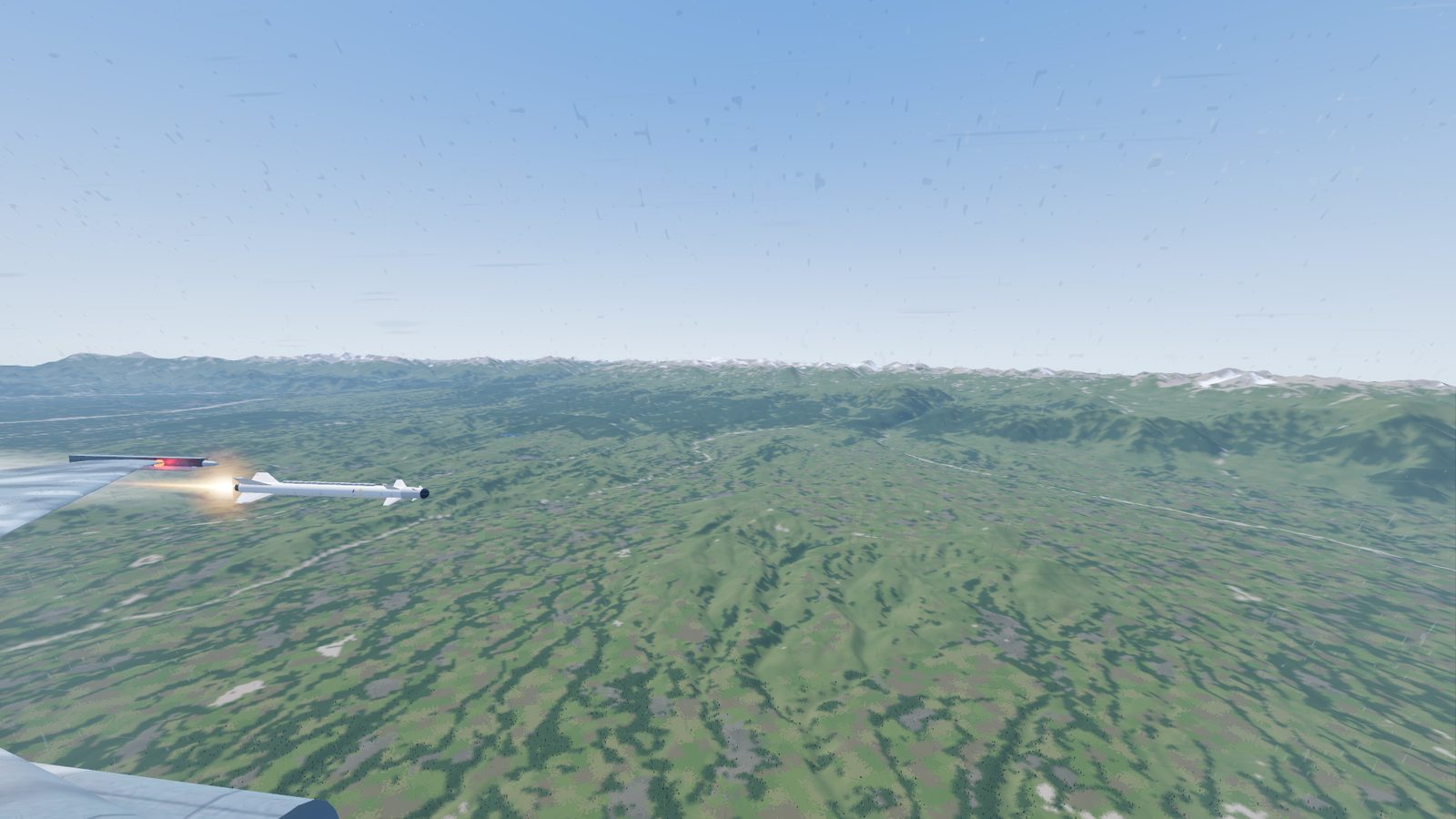
Every missile in FlightOut is flown by real physics: a rocket motor that burns for a few seconds, drag that grows sharply near the speed of sound, gravity, and a limit on how hard it can turn. After the motor burns out the missile coasts, slowing down all the time. A missile that has to chase a target running away, or turn hard late in its flight, runs out of energy and falls short.
The three ways a missile finds its target
| Guidance | Missiles | How it works | What it needs from you |
|---|---|---|---|
| IR (infrared, heat-seeking) | R-73, R-27T, R-27ET | A seeker in the nose sees the target's heat, mostly his engines | Its seeker must lock before launch (steady tone). After launch it needs nothing: fire and forget |
| SARH (semi-active radar homing) | R-27R, R-27ER | The missile homes on the reflections of your radar off the target | Your radar locked on that target for the whole flight |
| ARH (active radar homing) | R-77 | Flies on your lock at first; in the last 15 km its own radar takes over | Your lock until it's within 15 km of the target; then nothing. It can even be fired without a lock |
The missiles
R-73 (AA-11 "Archer")
The short-range dogfight missile, and the most agile thing in the sky. Its seeker can look 45° off your nose at launch and 75° once flying, and small vanes in its exhaust let it turn hard straight off the rail. It can follow a target crossing its view at up to 90° a second.
- Heat-seeking. Carried only on the wingtip and outer wing stations (1, 2, 9, 10).
- Fire it up to 8 G: the only missile you can launch in a hard turn.
- Short burn (5.5 s), short life: guidance lasts 23 seconds.
- Small warhead: it must pass within 5 m of the target to go off.
R-27R (AA-10 "Alamo-A")
The basic medium-range radar missile. It homes on your radar's lock.
- Semi-active radar. Fire it at up to 5 G.
- Two-stage motor, 6 s in all. Guidance for 45 seconds.
- Big warhead (39 kg): bursts within 9 m and does damage out to 40 m.
R-27ER (AA-10 "Alamo-C")
The R-27R with a much bigger motor: the longest-ranged missile you have, and the default radar missile in the CAP load-out.
- Semi-active radar. Fire at up to 5 G.
- Motor 8 s, guidance for 60 seconds. It reaches Mach 3.3 at low level and over Mach 4 high up.
- The same big warhead as the R-27R.
R-27T (AA-10 "Alamo-B")
The R-27R's airframe with a heat-seeking head instead of the radar one.
- Heat-seeking, lock before launch. Fire at up to 5 G.
- Seeker: 50° off the nose at launch, 55° in flight. It follows slowly-crossing targets only (up to about 30° a second).
- Same motor and life as the R-27R (45 s).
R-27ET (AA-10 "Alamo-D")
The extended-range R-27 with a heat-seeker: a long, silent shot. The target's warning receiver can't hear it.
- Heat-seeking, lock before launch. Fire at up to 5 G.
- The R-27ER's motor and 60-second life.
- In practice its range is set by how far its seeker can see the target, not how far it can fly: see How far a heat-seeker can see.
R-77 (AA-12 "Adder")
The active radar missile: it carries its own radar for the last part of the flight. In FlightOut you can load it on stations 3 to 8 (the real Su-27S didn't carry it; later Flankers do).
- Flies on your lock while far from the target. Within 15 km of it, its own radar takes over and your lock no longer matters: fire and forget.
- If you lose the lock while it's still far away, it keeps flying towards where the target was going, and its radar looks for him when it gets there.
- Can be fired with no lock at all (a "blind" or "maddog" shot): it flies straight on and takes the first aircraft it sees within 20° of its nose and 15 km, friend or foe.
- Fire at up to 6 G. Motor 6.5 s, guidance for 60 seconds.
- Bursts within 7 m.
Comparison
| R-73 | R-27R | R-27T | R-27ER | R-27ET | R-77 | |
|---|---|---|---|---|---|---|
| Guidance | IR | SARH | IR | SARH | IR | ARH |
| Launch mass | 105 kg (231 lb) | 253 kg (558 lb) | 245 kg (540 lb) | 350 kg (772 lb) | 343 kg (756 lb) | 175 kg (386 lb) |
| Motor burns | 5.5 s | 6 s | 6 s | 8 s | 8 s | 6.5 s |
| Top speed at 1 km / 10 km | Mach 2.7 / 3.5 | Mach 2.4 / 3.0 | Mach 2.4 / 3.1 | Mach 3.3 / 4.4 | Mach 3.3 / 4.4 | Mach 3.0 / 3.8 |
| Most G it can pull | 40 G | 25 G | 25 G | 25 G | 25 G | 35 G |
| Seeker angle: at launch / in flight | 45° / 75° | 50° / 60° | 50° / 55° | 50° / 60° | 50° / 55° | 50° / 60° |
| Fire at up to | 8 G | 5 G | 5 G | 5 G | 5 G | 6 G |
| Minimum range | 300 m | 800 m | 800 m | 1,000 m | 1,000 m | 800 m |
| Guidance lasts | 23 s | 45 s | 45 s | 60 s | 60 s | 60 s |
| Bursts within | 5 m | 9 m | 9 m | 9 m | 9 m | 7 m |
| Damages out to | 20 m | 40 m | 40 m | 40 m | 40 m | 36 m |
Top speeds are for a launch at 900 km/h (486 kt), straight and level.
How far each missile reaches
The HUD works out the launch zone for you (see Firing missiles). As a guide, these are the zones with you and the target both at 900 km/h (486 kt), at your height:
| Height | Target's direction | R-73 | R-27R / R-27T | R-27ER / R-27ET | R-77 |
|---|---|---|---|---|---|
| 1 km (3,300 ft) | Coming at you | 17 km | 29 km | 40 km | 37 km |
| Crossing | 11 km | 18 km | 25 km | 22 km | |
| Flying away | 5 km | 6 km | 10 km | 7 km | |
| No escape | 4.6 km | 5.5 km | 9.8 km | 7.0 km | |
| 5 km (16,400 ft) | Coming at you | 19 km | 33 km | 46 km | 42 km |
| Crossing | 14 km | 21 km | 31 km | 27 km | |
| Flying away | 7 km | 9 km | 15 km | 11 km | |
| No escape | 7.1 km | 8.4 km | 14.6 km | 10.6 km | |
| 10 km (32,800 ft) | Coming at you | 23 km | 39 km | 57 km | 51 km |
| Crossing | 17 km | 27 km | 42 km | 36 km | |
| Flying away | 11 km | 16 km | 27 km | 20 km | |
| No escape | 10.8 km | 15.3 km | 25.9 km | 19.2 km |
- Higher is longer: thin air means less drag.
- Faster is longer: a fast launch gives the missile a running start.
- A target coming at you closes the gap himself; one running away has to be chased.
- No escape is the range inside which he can't outrun it even if he turns and flies away at full speed.
How far a heat-seeker can see
An IR missile can only be fired once its seeker has locked, and its seeker only sees so far. That range depends on which side of the target you see and whether he's in afterburner:
| You see the target from | R-73 | R-27T | R-27ET |
|---|---|---|---|
| In front (head-on) | 4 km | 5 km | 6 km |
| 45° off his nose | 4.4 km | 5.7 km | 6.8 km |
| The side | 6.8 km | 9.6 km | 10.9 km |
| 45° off his tail | 10.3 km | 15.3 km | 17 km |
| Behind | 12 km | 18 km | 20 km |
| ...in afterburner | 2.2 times as far | 2.2 times as far | 2.2 times as far |
- His engines and exhaust are the hot part, so the view from behind is best.
- Afterburner makes a jet visible from more than twice as far. Below afterburner, idle and full power look the same.
- So the R-27ET's long head-on zone (40 km and more) is never usable: head-on, its seeker sees a jet only inside about 6 km, or 13 km if he's in full afterburner. Its long shots are from the side or behind, at a jet in afterburner.
Warheads and damage
Each missile has a proximity fuze: it goes off when it passes close to any part of an aircraft. The burst throws fragments that damage every part of every aircraft nearby, more the closer it is.
- R-27s (39 kg warhead): a burst within about 10 m usually tears off a fin, a tailplane or an outer wing and holes several other parts. It damages out to 40 m.
- R-77 (22 kg): a little less; damages out to 36 m.
- R-73 (7.4 kg): it has to come very close, and heat-seekers aim at the engines: a typical R-73 hit wrecks the tail, the engines and sets them on fire.
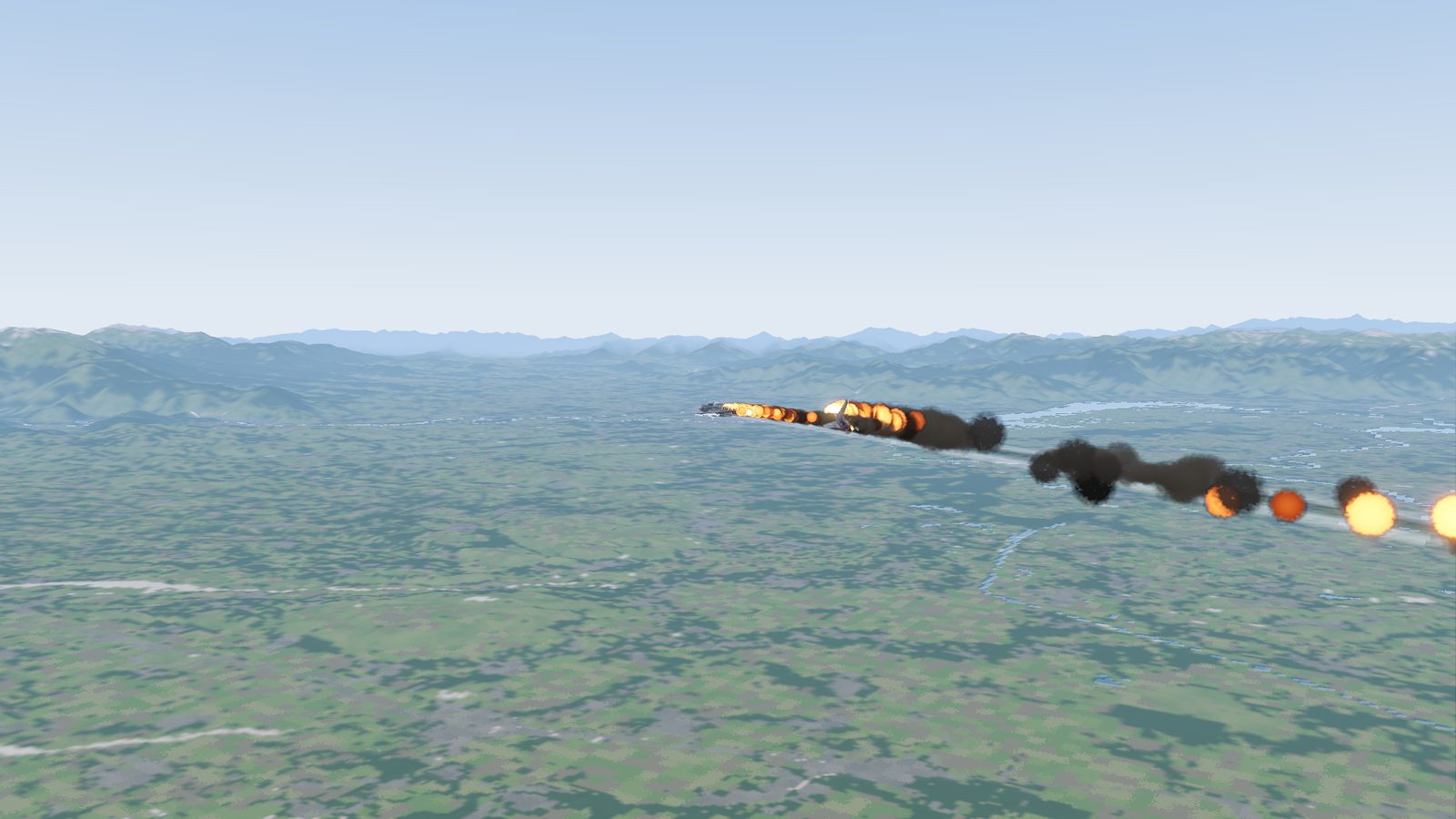
A missile that passes wider than its fuze distance doesn't go off at all. One that runs out of guidance falls and blows itself up at the end of its life; if it hits the ground first, it does no damage.
The fuze can't tell friend from foe: a missile goes off next to any aircraft it passes, including a friendly or, after 3 seconds, the jet that fired it. See Air combat for what being hit is like.
What isn't modelled yet
- Flares and chaff: there are none, so missiles can't be decoyed.
- Lofting: missiles fly the most direct path; none of them climb first to go farther.
- Datalink updates: the real R-27 and R-77 can get course corrections in flight; here the R-27R/ER simply need your lock all the way.
Checked against FlightOut 0.5.2.