
Engines and fuel
The throttle, the afterburner, how the engines respond, how much fuel you burn, and refuelling on the ground.
On this page
The Su-27 has two turbofan engines with afterburners. You fly them with one throttle that moves both together.
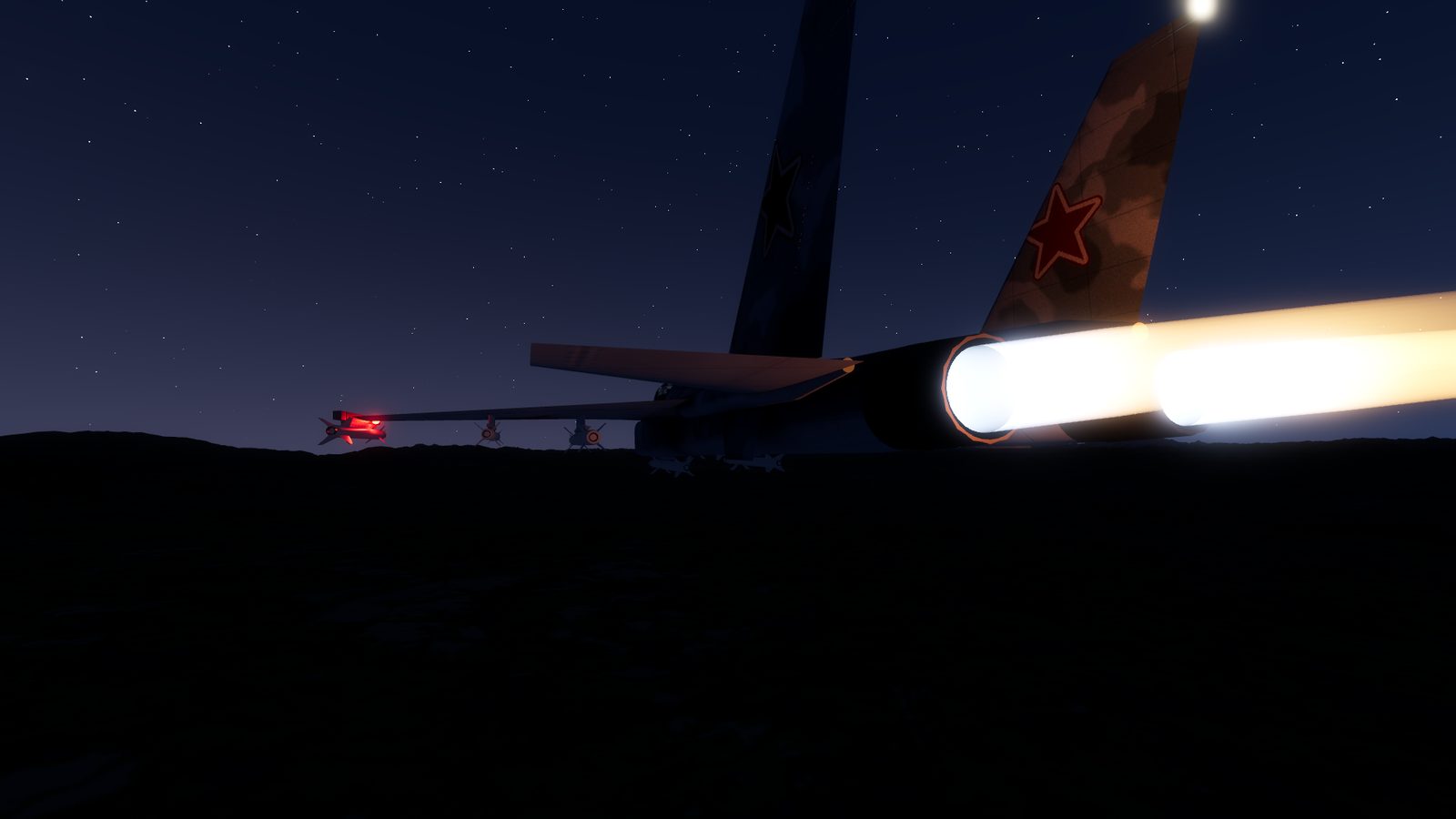
Starting up
There is no engine start to do. Every time you spawn or respawn, the engines are already running at idle. There is no battery, generator or starter to work, and the ENGINE START panel on the left console has no working switches. Its START lamps light when an engine has run down, for example out of fuel.
The engines can't be shut down either: they keep running as long as there is fuel and they are not destroyed.
The throttle
| Key | Does |
|---|---|
| Shift (hold) | More power |
| Ctrl (hold) | Less power |
The throttle moves at 40% a second, so idle to full afterburner takes 2.5 seconds. On the left console you can watch it slide past three marks:
| Mark | Throttle | What you get |
|---|---|---|
| IDLE | 0% | 68% rpm, almost no thrust |
| MIL | 85% | Full power without afterburner (military power) |
| MAX | 100% | Full afterburner |
The SYS page on the displays shows the throttle as a percentage.
How the engines respond
- They take time. From idle the engines take about 3 seconds to reach 90% rpm and about 4.5 seconds to reach 96%. Spooling down, they lose the first 20% in about 2 seconds.
- The afterburner lights only near full power. Push the throttle past MIL (85%). Once the engines reach about 96% rpm, the afterburner lights after a short delay, about 0.7 seconds, with a thump you can hear. It then builds up to full thrust over about a second. From idle, the afterburner lights about 5 seconds after you push the throttle all the way forward.
- The afterburner is stepless. Anywhere between MIL and MAX gives you part afterburner.
- Altitude changes everything. Thrust falls as the air gets thinner, and so does the fuel burn. Speed helps: the engines give more thrust the faster you go.
Fuel
| Internal tanks | 9,400 kg (20,720 lb) in four tanks in the fuselage and wings |
| At the start of a flight | 5,200 kg (11,460 lb), a bit over half |
| External tanks | none |
How fast you burn it, roughly, with both engines, standing at sea level:
| Power | Fuel burn | The default 5,200 kg lasts |
|---|---|---|
| Idle | about 270 kg (600 lb) an hour | |
| MIL | about 11 tonnes an hour | about half an hour |
| Full afterburner | about 28 tonnes an hour | about 11 minutes |
Flying fast at low level burns more: full afterburner at Mach 0.9 is nearer 38 tonnes an hour. Up high the burn is much lower, so climb for range. The SYS page shows your fuel, the burn right now and how many minutes that leaves you.
Running low
- Below 1,000 kg (2,200 lb) the LOW FUEL lamp lights and a chime sounds once.
- When the tanks run dry, both engines wind down and give no thrust. The controls still work, so glide to the nearest runway. The engines come back by themselves after refuelling.
Leaks
A hit can hole a tank, and the fuel leaks out. Losing a piece of the jet loses the fuel inside it. Keep an eye on the fuel after taking damage.
Refuelling and rearming
The ground crew refuel you on the ground, from the WPN page of the displays:
- Land and come to a complete stop. The crew won't work on a moving or crashed jet.
- On the WPN page, use FUEL up and down to choose the load, in steps of a quarter of the tanks. You can take fuel off as well as on.
- Wait. It takes a few seconds plus the time to pump the fuel. If the jet moves, the crew stop.
The same page lets the crew load missiles: see Displays.
Engine fire and damage
- A hit on an engine can set it on fire. The FIRE L or FIRE R lamp lights.
- There is no fire extinguisher. A fire destroys its engine in about 40 seconds, and then the rear of the jet.
- A damaged engine gives less thrust, and a destroyed one none. The Su-27 flies on one engine, so you can still limp home.
Checked against FlightOut 0.5.2.