Approach and landing
Landing the Su-27: the practice approach, the HUD landing guidance, the PAPI and runway lights, the touchdown and stopping.
On this page
The practice approach
The quickest way to practise landing: press P, or PRACTICE APPROACH in the pause menu. Offline only.
- You are placed 7 km from the nearest runway's aiming point, lined up, on a 3° glide path, about 370 m (1,200 ft) above the runway.
- Gear down, flaps down, at 280 km/h (152 kt).
- The auto-throttle holds that speed. Move the throttle (Shift or Ctrl) to take over.
- The jet is fresh: repaired, refuelled to 5,200 kg and rearmed. The autopilot is switched off.
- Your master mode is kept: press 1 for NAV to get the landing guidance and the landing warnings.
- The HUD shows the held speed as A 152 (A 281 in metric).
The runway chosen is the one whose end is nearest you on the whole map, whatever the wind. From the offline start that's Srinagar 13.
Setting up your own approach
- Slow down below 500 km/h (270 kt) and lower the gear (G). The HUD shows GEAR, and three green lamps light on the panel.
- Lower the flaps (F).
- Line up with the runway several kilometres out and settle at about 280 km/h (152 kt).
- Stay in NAV mode (1): the landing guidance only appears in NAV, and the SINK RATE and GEAR warnings are quiet in the combat modes.
At 280 km/h on the glide path the jet descends at about 4 m/s (800 ft/min) with the nose about 10° above the flight path.
The HUD landing guidance
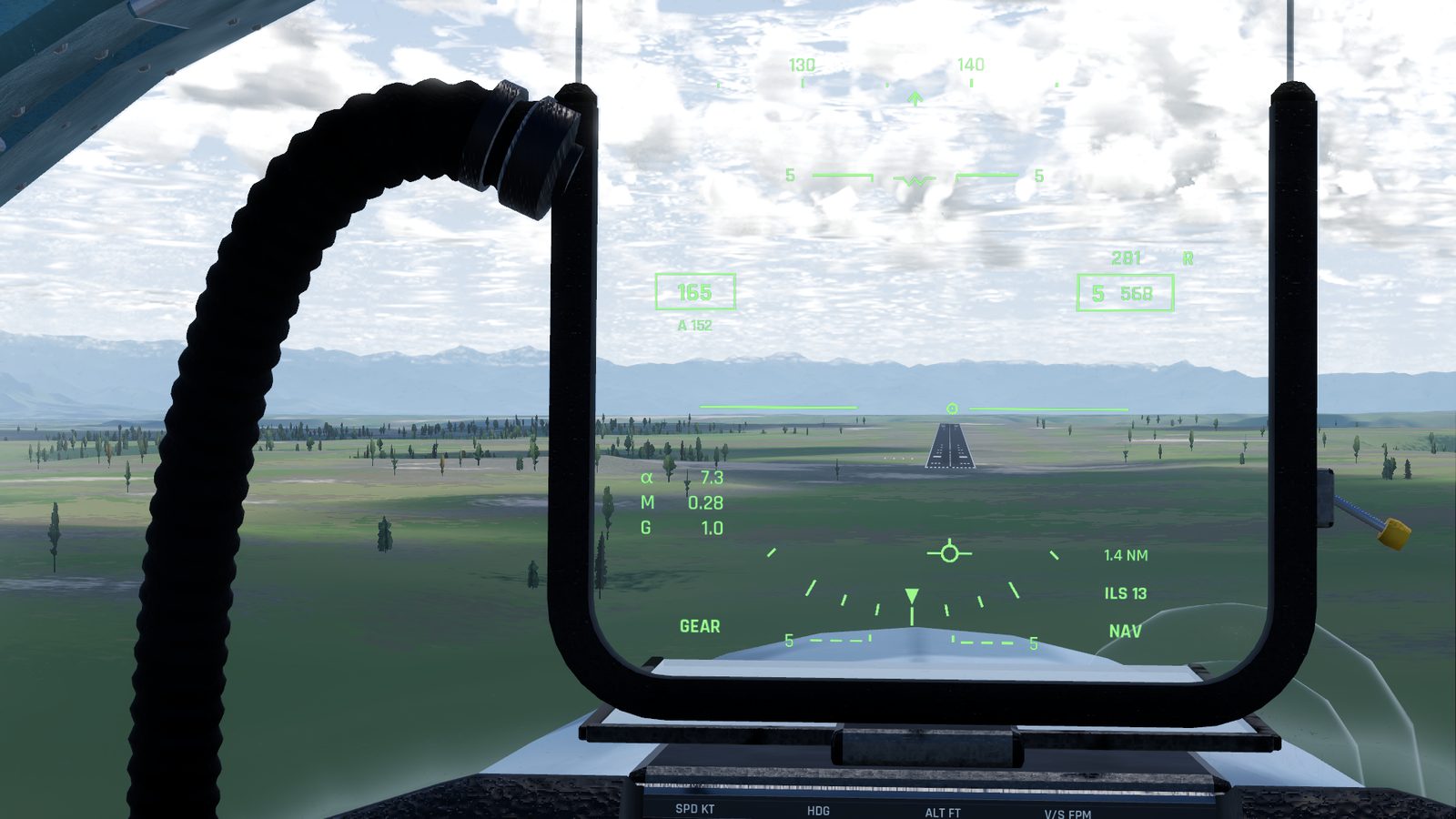
Every runway in FlightOut has landing guidance. There is nothing to tune: it appears by itself when all of these are true:
- NAV master mode;
- gear down, in the air;
- between 25 km and 150 m from the runway's aiming point;
- within about 35° either side of the runway's extended centreline;
- the nose pointing within 60° of the runway direction.
What it shows:
- The cue: a small circle with a dot. Fly the flight path marker onto it and keep it there. The cue leads you onto the centreline and down the 3° glide path, aiming at a point 300 m past the runway threshold. Below the glide path it asks for level flight until you meet it; it never asks you to climb.
- The runway's name, such as ILS 13, and the distance to the aiming point, in nautical miles or kilometres.
It disappears when you get within 150 m of the aiming point, and at touchdown. In a crosswind, keep the uncaged flight path marker on the cue: it takes care of the drift.
The PAPI
The four lights on the left of the runway, beside the aiming point, show your glide path. They work day and night:
| You see | You are |
|---|---|
| 2 white, 2 red | On the glide path (3°) |
| 3 white, 1 red | Slightly high |
| 4 white | Too high |
| 1 white, 3 red | Slightly low |
| 4 red | Too low |
The PAPI reads from where the camera is, so use it from the cockpit view.
Runway lights
From late evening to early morning (roughly 18:00 to 06:00 game time), every runway has:
- white edge lights along both sides;
- a green bar across the threshold, and a red bar across the far end;
- approach lights: a line of white lights 900 m out from the threshold, with a crossbar 300 m out.
They don't come on in daytime fog or rain, so set the time of day accordingly if you want to practise a night landing.
Touchdown
- Keep the flight path marker on the aiming point: about 300 m past the threshold, level with the PAPI and just short of the two large painted blocks.
- Just before the wheels touch, raise the nose a little to slow the descent. Don't overdo it: more than about 12° nose-up strikes the tail.
- Aim to touch down sinking at less than 3 m/s (590 ft/min). At 7 m/s (1,380 ft/min) or more the gear collapses. Watch the VVI.
You'll hear the thump of the wheels and the tyres chirp. If the auto-throttle was holding your speed, it closes the throttle to idle at touchdown.
Stopping
- Close the throttle (Ctrl) and hold Space for the brakes.
- From 270 km/h (146 kt), full braking stops the jet in about 860 m, in about 23 seconds.
- Without brakes it rolls for more than 5 km. The jet has no drag chute or thrust reversers.
- The airbrake (B) helps a little at high speed.
On the shortest runways, such as Beas (about 1,200 m), touch down right at the start and brake hard.
Missed approach
Not happy? Full power (Shift), raise the nose to about 10°, gear up once climbing, flaps up, and come round again.
Checked against FlightOut 0.5.2.