Su-27 Flanker
The real Su-27, its numbers in FlightOut, and what is simulated and what is simplified.
On this page
The real aircraft
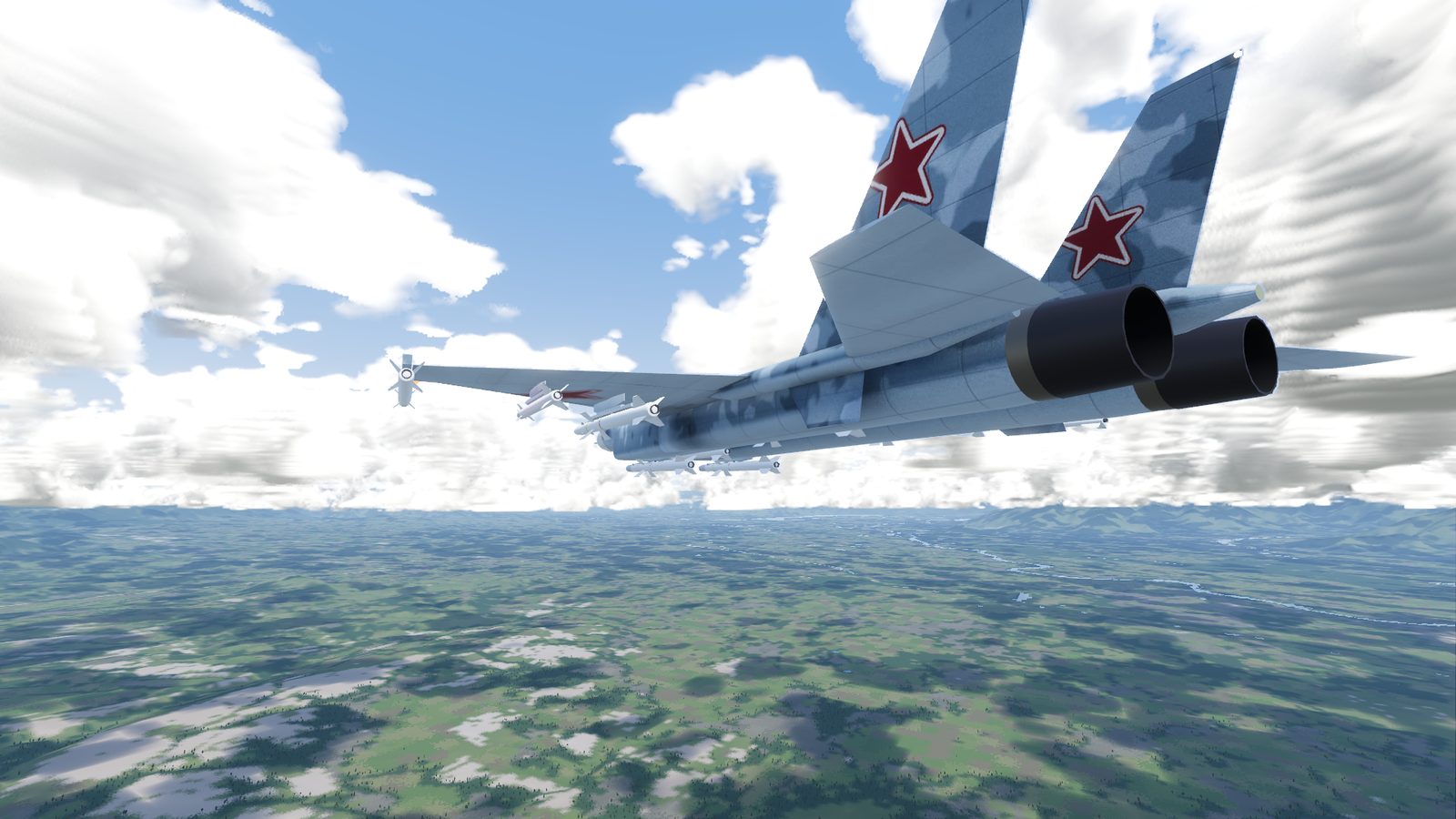
The Sukhoi Su-27 is a large twin-engine, single-seat fighter from the Soviet Union, built to win control of the air at long range and in close combat. It entered service in the mid-1980s and its NATO reporting name is Flanker. FlightOut models the Su-27S (Flanker-B), the main production single-seater.
The Flanker is known for its long range, its large internal fuel load, its ten weapon stations and its agility at low speed, shown off by the famous Cobra manoeuvre.
The jet in numbers
| FlightOut Su-27S | |
|---|---|
| Wing span | 14.7 m (48 ft) |
| Wing area | 62 m² (667 ft²) |
| Empty mass | 16,380 kg (36,110 lb) |
| Internal fuel | 9,400 kg (20,720 lb) |
| Fuel at the start of a flight | 5,200 kg (11,460 lb) |
| Mass at the start, with the default missiles | about 24,800 kg (54,600 lb) |
| Engines | 2 turbofans with afterburner |
| Thrust per engine, without afterburner | 79.4 kN (17,850 lbf) |
| Thrust per engine, full afterburner | 122.6 kN (27,560 lbf) |
| G limit | +9 G and -3 G up to 21,400 kg; less when heavier |
| Angle of attack limit | 26 degrees (less at high speed) |
| Speed limit | 1,400 km/h (756 kt) indicated, and Mach 2.35 |
| Landing gear limit | 500 km/h (270 kt) |
| Gun | 150 rounds, about 6 seconds of firing |
There is no fixed top speed or ceiling: they come out of the thrust, the drag and the thin air, as they would in the real jet.
How the G limit changes with weight
The structure is rated for 9 G at 21,400 kg. A heavier jet can pull less, and the flight controls lower the limit for you:
| Load | G limit |
|---|---|
| No missiles, 4,300 kg of fuel or less | 9.0 G |
| No missiles, 5,200 kg of fuel | 8.6 G |
| Default start: 5,200 kg of fuel and the default missiles | 7.8 G |
| Full fuel and the default missiles | 6.6 G |
What is simulated
- Real flight physics. The jet moves freely in all directions, and its weight changes as fuel burns and missiles leave the rails.
- Fly-by-wire controls. The stick asks for G and roll rate, the computer moves the control surfaces, and it keeps you inside the G and angle of attack limits. No trim is needed. See Flight controls.
- Stalls. Buffet as you near the stall, wing rock and wing drops beyond it. With the limiter overridden you can stall and depart.
- High speed. Lift and drag change near and beyond the speed of sound, and the jet's stall angle falls as it goes faster.
- Thin air. Thrust and fuel burn fall with altitude, and the jet needs more speed to fly in the thin air of Kashmir's high airfields.
- Ground effect close to the runway, wind, which is lighter near the ground, and turbulence, which is stronger there.
- Engines that take time to spool up and an afterburner that lights after a short delay. See Engines and fuel.
- Landing gear with working suspension, wheel brakes, nose-wheel steering and tail strikes. See Landing gear and brakes.
- Damage. Hits, fires, fuel leaks, lost hydraulics, overstress and parts breaking off.
- G effects on the pilot. Greyout, tunnel vision, blackout and red-out, set in Cockpit settings.
What is simplified or left out
- No engine start and no electrics. The engines are running when you spawn, and there is no battery, generator or starter to work.
- The engines can't be shut down. They run while there is fuel and they are not destroyed.
- No trim. The fly-by-wire holds your flight path with the stick centred.
- No drag chute.
- Some cockpit panels are not wired yet. Several side-console panels are titled but blank. The cockpit tour lists what works.
- Hydraulics only fail from battle damage.
Checked against FlightOut 0.5.2.