Flight controls
How the Su-27's fly-by-wire responds to the stick, its G and angle of attack limits, overriding them for the Cobra, stalls and hydraulics.
On this page
The Su-27 in FlightOut flies through a fly-by-wire system: your stick and pedals tell a flight computer what you want, and it moves the control surfaces to get it, inside the jet's limits.
What the stick does
| Input | Keys | What you are asking for |
|---|---|---|
| Pitch | W / S or the arrow keys | G. Pull for more G, push for less. Centred, the jet holds its flight path |
| Roll | A / D or the arrow keys | Roll rate, up to 240 degrees a second at full stick when the jet has the speed for it |
| Yaw | Q / E | A push of the nose sideways. Turns are coordinated for you, so you rarely need it in the air |
What this means when you fly:
- No trim, ever. Let go of the stick and the jet keeps flying where it was pointed, even in a banked turn of up to 70 degrees. The three TRIM lamps between your knees stay lit to say the trim is neutral.
- Turns are clean. You don't need the pedals to balance a turn; the computer does it.
- Rolling is about your flight path, not the jet's nose, so the jet stays on its line as it rolls.
The limiter
The flight computer keeps you inside two limits, so you can pull as hard as you like without stalling or breaking the jet:
| Limit | Value |
|---|---|
| Angle of attack | 26 degrees nose-up, 10 degrees nose-down. Less at high speed, where the wing stalls sooner |
| G | +9 G and -3 G when the jet weighs 21,400 kg or less; lower when it's heavier: about 7.8 G with the default fuel and missiles |
At full aft stick you get the most the jet can give within those limits. Your pitch rate is also capped, at about 29 degrees a second.
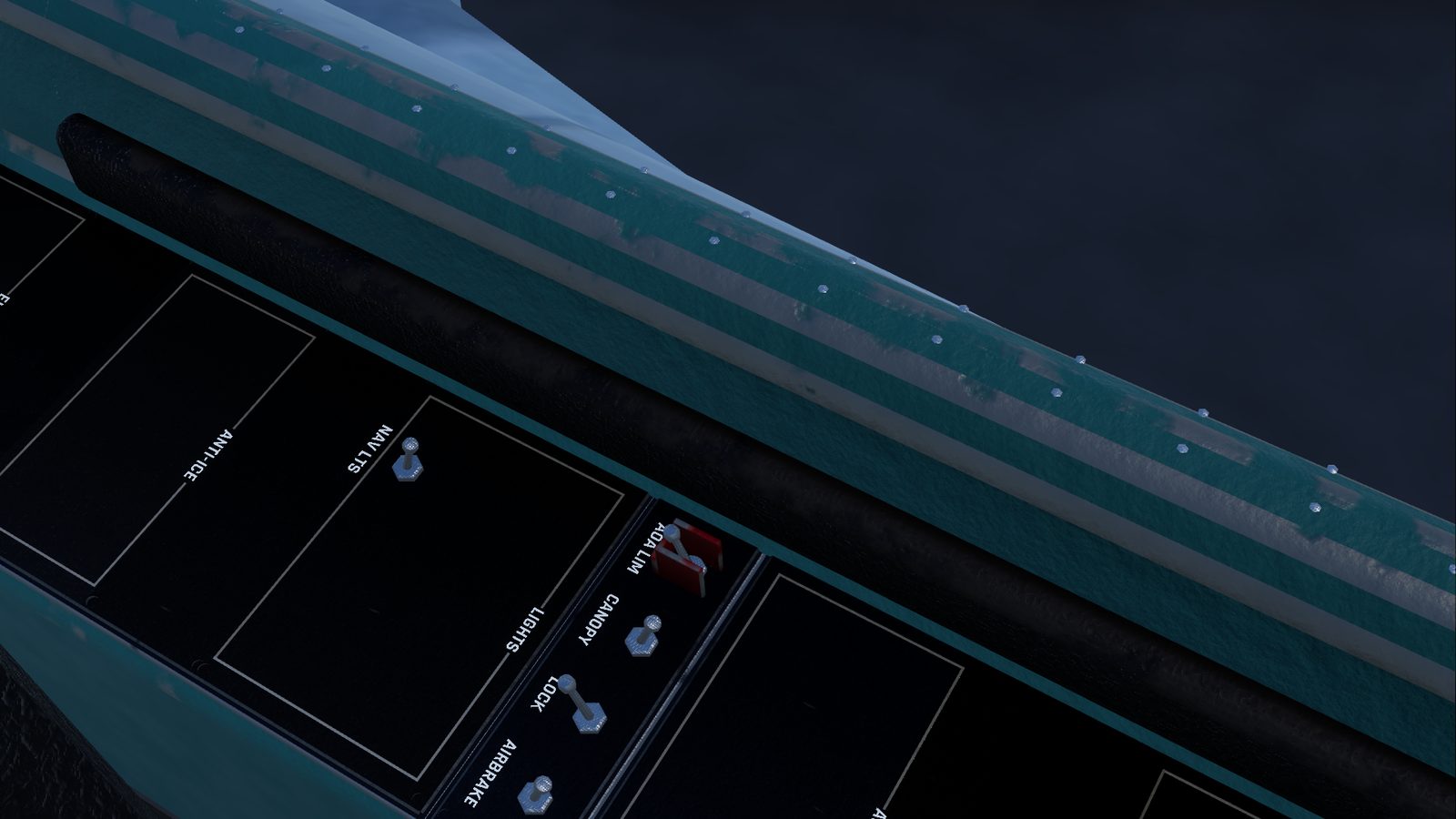
The limiter's switch is AOA LIM, under a red guard on the left console. The key is K. When it is off, the amber SDU lamp lights.
Overriding it: the Cobra
Switching the limiter off doesn't take the limits away straight away. They drop out only while you hold the stick more than about a third of the way back. Then:
- the jet can pitch up much faster and well past 26 degrees: this is how you fly the Cobra;
- it can stall, drop a wing and depart;
- it can overstress: past the G limit the wing spars bend and stay weaker; at one and a half times the limit a wing breaks off. Rolling while pulling hard loads one wing more than the other.
Ease the stick forward past a third and the limits come back at once, bringing the nose down for you, even with the switch still off.
To try a Cobra: fly level at a moderate speed (the real Su-27 does it at about 400 to 450 km/h, 215 to 245 kt), switch the limiter off with K, then pull the stick fully back and hold it. The nose pitches up steeply while the jet carries on almost level, shedding speed fast. Let go of the stick to bring the nose back down, then add power and switch the limiter back on. Leave yourself plenty of height while you practise.
Stalls
Even with the limiter on you can get close to the stall at low speed.
- Buffet starts at about two-thirds of the stall angle: the jet shakes.
- STALL lamp and voice warning when you go deep into it.
- Past the stall: wing rock, sudden wing drops, and the nose wants to slice sideways. The ailerons stop working well.
To recover: push the stick forward to lower the nose, level the wings, and add power. The autopilot switches itself off in a deep stall.
The stall angle is about 33 degrees clean and about 36 with the leading-edge slats out. The slats start to come out by themselves at about 8 degrees and are fully out by 18, so in practice the stall comes at about 36 degrees at low speed. They are also out whenever the flaps are down. At high speed the stall comes much sooner: by Mach 1.2 it is about half that.
On the ground
- On the runway the stick moves the control surfaces directly, as in a simple aircraft, up to about 160 km/h (87 kt). The fly-by-wire takes over smoothly by about 230 km/h (126 kt).
- Q and E steer the nose wheel: sharply at taxi speed, only gently at take-off speed.
- Pull back too hard on the ground and you can strike the tail. See Landing gear and brakes.
Hydraulics
The control surfaces are moved by hydraulics. In this version the hydraulics only fail from battle damage:
| Hydraulic pressure | What you notice |
|---|---|
| Full down to 30% | Nothing; the controls work normally |
| Below 30% | The surfaces move less far and more slowly. The jet gets sluggish |
| 0 | The controls stop answering. Eject |
Losing a wing halves the pressure or less; losing both wings or the rear of the jet, or a fire that engulfs it, takes it all. The HYD 1 lamp lights at half pressure and HYD 2 when it is almost gone. The HYD gauge and the SYS page show the same pressure.
If you black out
If you black out under G, the stick and pedals centre and the fly-by-wire holds the flight path until you come round. If the pilot is killed, the controls stay where they were and the jet flies on without you. G effects are explained in Cockpit settings.
Checked against FlightOut 0.5.2.